Web Application Security Testing : key concepts you need to know
Web application security testing is critical to protect both your apps and your organization. Your web applications are likely to be the #1 attack vector for malicious individuals seeking to breach your security defenses. Available to users 24/7, web apps are the easiest target for hackers seeking access to confidential back-end data.
Web application security has become a major concern for businesses of all shapes and sizes.
Web application security is referred to as safeguarding of websites, web applications, and web services from existing and emerging security threats that exploit weaknesses in application source code.
Web application penetration testing
Web application penetration testing is a process by which Cyber Security Experts simulate a real-life cyber-attack against web applications, websites, or web services to identify probable threats.
This is done in a bid to determine the current vulnerabilities that would be easily exploitable by cybercriminals. Within an organisation, web servers available locally or on the cloud are at high risk of a potential attack from malicious sources.
With penetration testing, Cyber Security Experts conduct a series of simulated attacks that replicate actual unauthorised cyber-attacks, check the vulnerability’s extent, and identify loopholes and the efficacy of overall application security posture of the organisation.
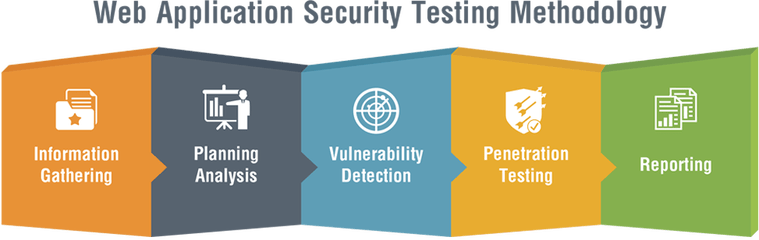
Web Application Security Testing Methodology
- Information Gathering
- Planning Analysis
- Vulnerability Detection
- Penetration Testing
- Reporting
Information Gathering
During the Information Gathering phase of web application penetration testing, also known as reconnaissance, the goal is to gather as much information as possible about the target web application and its underlying infrastructure. This phase helps identify potential vulnerabilities and attack vectors that can be used in later stages of the penetration test. Here are some key steps and techniques involved in the Information Gathering phase:
- Passive Information Gathering:
- Search engines: Utilize search engines like Google, Bing, and Shodan to find information about the target, including web pages, subdomains, exposed services, and potentially sensitive information.
- Social media: Analyze publicly available information from social media platforms to gather details about the target organization, its employees, and any potential connections.
- WHOIS lookup: Perform WHOIS queries to discover domain registration information such as registrant details, email addresses, and DNS servers.
- DNS enumeration: Use tools like
nslookup,dig, or online DNS enumeration services to identify subdomains and associated IP addresses.
- Active Information Gathering:
- Port scanning: Conduct port scans using tools like Nmap to identify open ports and services running on the target’s IP addresses.
- Banner grabbing: Extract service banners and version information from open ports to determine potential vulnerabilities.
- Web scraping: Use automated tools or scripts to extract information from the target’s website, such as directories, file names, and hidden content.
- Reverse IP lookup: Identify other websites hosted on the same IP address or IP range, which may reveal shared infrastructure or potential attack vectors.
- Technology Profiling:
- Web server fingerprinting: Determine the web server software (e.g., Apache, Nginx) and its version to uncover known vulnerabilities associated with the specific software.
- Content management system (CMS) identification: Identify if the target website is built on a popular CMS like WordPress, Joomla, or Drupal, as this knowledge can assist in finding vulnerabilities specific to those platforms.
- Framework and library identification: Identify any frameworks (e.g., Django, Ruby on Rails) or JavaScript libraries (e.g., jQuery, React) in use, as outdated versions may be vulnerable.
- Information Gathering Tools:
- Recon-ng: A powerful reconnaissance framework that automates various information-gathering techniques.
- TheHarvester: A tool for gathering email addresses, subdomains, and other related information using public sources.
- Shodan: A search engine for discovering devices and services connected to the internet, allowing for specific searches related to the target.
- Maltego: A graphical tool for visualizing and linking information, useful for mapping relationships between domains, IPs, and individuals.
Planning Analysis
During the Information Planning Analysis phase of web application penetration testing, the goal is to analyze the gathered information and plan the subsequent steps of the penetration testing process. This phase helps in understanding the target application’s architecture, identifying potential vulnerabilities, and determining the most effective testing techniques. Here are some key steps involved in the Information Planning Analysis phase:
- Target Analysis:
- Application Mapping: Understand the target application’s functionality, components, and entry points. Identify all available web pages, forms, APIs, and other relevant elements.
- User Roles and Permissions: Determine the different user roles and their associated privileges within the application. This analysis helps in testing authorization and access control vulnerabilities.
- Input Validation and Output Handling: Analyze how the application handles user input, including input validation mechanisms and output encoding. This analysis helps identify potential input-based vulnerabilities like SQL injection or Cross-Site Scripting (XSS).
- Vulnerability Analysis:
- Threat Modeling: Identify potential threats and attack vectors specific to the target application. Consider both technical and business impact factors.
- OWASP Top 10: Refer to the Open Web Application Security Project (OWASP) Top 10 list to identify common web application vulnerabilities that are relevant to the target application.
- Secure Configuration Review: Analyze the application’s configuration settings, such as the web server, database, and application server, to ensure they are properly configured and don’t expose sensitive information or have default credentials.
- Testing Methodology Selection:
- Select Testing Techniques: Determine the appropriate testing techniques based on the target application’s characteristics, vulnerabilities, and available resources. This may include manual testing, automated scanning, or a combination of both.
- Prioritize Vulnerabilities: Based on the severity and potential impact, prioritize the vulnerabilities to focus on during the testing phase. This helps in efficiently allocating time and resources.
- Test Plan Preparation:
- Define Test Objectives: Clearly define the goals and objectives of the penetration test, such as identifying specific vulnerabilities or validating the effectiveness of security controls.
- Define Test Scenarios: Develop specific test scenarios and attack vectors based on the identified vulnerabilities and testing techniques to be used.
- Develop Test Cases: Create detailed test cases that outline step-by-step instructions for conducting each test scenario. This ensures consistency and reproducibility during the testing process.
- Documentation and Reporting:
- Establish Reporting Criteria: Define the format and content requirements for the penetration test report. Consider including detailed descriptions of vulnerabilities, their potential impact, and recommended remediation measures.
- Document Findings: During the planning phase, document all relevant information, including the identified vulnerabilities, supporting evidence, and associated risk levels.
- Define Mitigation Recommendations: Prepare recommendations for addressing the identified vulnerabilities, prioritized based on risk severity.
Remember, it is crucial to maintain clear communication with stakeholders throughout the planning phase and ensure that the penetration testing activities align with the scope and goals of the engagement.
Vulnerability Detection
During the Vulnerability Detection phase of web application penetration testing, the focus is on actively identifying and exploiting vulnerabilities within the target web application. This phase involves both manual and automated techniques to discover weaknesses in the application’s security controls. Here are some key steps and techniques involved in the Vulnerability Detection phase:
- Automated Scanning:
- Web Application Scanners: Utilize automated web application scanning tools such as Burp Suite, OWASP ZAP, or Acunetix to crawl the application, identify potential vulnerabilities, and perform security checks automatically.
- Vulnerability Scanners: Use vulnerability scanners like Nessus or OpenVAS to scan the underlying infrastructure, including web servers, databases, and network devices, for known vulnerabilities.
- Manual Testing:
- Input Validation Testing: Craft various inputs, including special characters, long strings, and unexpected data types, to test how the application handles them. Look for vulnerabilities like SQL injection, Cross-Site Scripting (XSS), or command injection.
- Authentication and Authorization Testing: Test the authentication and authorization mechanisms by attempting to bypass or abuse them. Look for vulnerabilities like weak passwords, insecure session management, or privilege escalation.
- Session Management Testing: Test how the application manages sessions and cookies. Look for vulnerabilities like session fixation, session hijacking, or insufficient session expiration.
- Business Logic Testing: Analyze the application’s logic and functionality to identify vulnerabilities like insecure direct object references, insecure file uploads, or insecure access control.
- Error Handling and Information Leakage Testing: Manipulate inputs and trigger errors to analyze how the application handles them. Look for potential information disclosure or error messages that reveal sensitive data.
- Client-Side Testing: Inspect and analyze the client-side code (HTML, JavaScript) for vulnerabilities like DOM-based XSS, insecure direct object references, or insecure data storage.
- Fuzzing:
- Input Fuzzing: Use fuzzing techniques to send malformed or unexpected inputs to the application, aiming to trigger unexpected behaviors or crashes that may indicate vulnerabilities.
- Protocol Fuzzing: Fuzz the application’s communication protocols, such as HTTP, to discover vulnerabilities like buffer overflows, protocol-specific weaknesses, or injection vulnerabilities.
- Security Headers and Configuration Analysis:
- Analyze the application’s security headers, such as Content-Security-Policy (CSP), X-Frame-Options, or HTTP Strict Transport Security (HSTS), to ensure they are correctly configured.
- Review the application’s configuration files, including web server settings, database configurations, and file permissions, to identify misconfigurations or insecure settings.
- Manual Code Review:
- Conduct a manual review of the application’s source code, focusing on high-risk areas like user input handling, authentication and authorization mechanisms, database queries, and file operations. Look for coding errors, insecure coding practices, or vulnerable code patterns.
- Third-Party Component Analysis:
- Identify and analyze third-party components, libraries, and frameworks used by the application. Check for known vulnerabilities associated with these components by referring to vulnerability databases like the National Vulnerability Database (NVD) or the Common Vulnerabilities and Exposures (CVE) list.
Throughout the Vulnerability Detection phase, document the identified vulnerabilities, including their severity, impact, and proof-of-concept (PoC) exploitation steps. Ensure regular communication with stakeholders and maintain proper authorization and scope adherence while conducting vulnerability detection activities.
Penetration Testing
During the Penetration Testing phase of web application security assessment, the focus is on actively exploiting vulnerabilities in the target application to assess its security posture. This phase involves conducting controlled attacks to determine the real-world impact and likelihood of successful exploitation. Here are the key steps involved in the Penetration Testing phase of web application security assessment:
- Threat Modeling and Scope Definition:
- Review the objectives and scope of the penetration testing engagement, ensuring a clear understanding of the target application and the allowed attack surface.
- Define the rules of engagement, including any constraints or limitations, to ensure the testing is conducted safely and within the agreed boundaries.
- Exploitation of Vulnerabilities:
- Prioritize the identified vulnerabilities based on their severity and potential impact on the application’s security.
- Utilize various techniques, including manual testing and automated tools, to exploit the vulnerabilities and gain unauthorized access or perform unauthorized actions.
- Attempt to compromise user accounts, escalate privileges, execute arbitrary code, or access sensitive data to assess the impact of successful exploitation.
- Validation and Verification:
- Validate the successful exploitation of vulnerabilities by obtaining proof-of-concept (PoC) evidence.
- Verify that the identified vulnerabilities can be consistently reproduced and demonstrate the impact on the application’s security.
- Test different scenarios and attack vectors to ensure thorough coverage of potential attack paths.
- Post-Exploitation Analysis:
- Analyze the compromised state to determine the extent of the damage and potential further exploitation opportunities.
- Assess the ability to maintain persistence within the application or associated infrastructure.
- Review the effectiveness of security controls, including incident response mechanisms, in detecting or mitigating the attack.
- Documentation and Reporting:
- Document all findings, including detailed descriptions of the vulnerabilities, their impact, and the steps taken to exploit them.
- Provide clear and actionable recommendations for remediation, including patches, configuration changes, and best practices.
- Classify the vulnerabilities based on their severity and potential business impact, enabling the stakeholders to prioritize remediation efforts effectively.
- Debriefing and Knowledge Transfer:
- Conduct a debriefing session with the stakeholders, including the application owners, development team, and relevant security personnel.
- Share the findings, recommendations, and insights gained during the penetration testing engagement.
- Provide guidance on mitigating the identified vulnerabilities and enhancing the application’s overall security posture.
Reporting
During the Penetration Reporting phase of web application penetration testing, the focus is on compiling the findings, observations, and recommendations into a comprehensive report. The report serves as a crucial deliverable that communicates the results of the penetration test to the stakeholders. Here are the key steps involved in the Penetration Reporting phase:
- Executive Summary:
- Provide an overview of the penetration testing engagement, including the scope, objectives, and methodology used.
- Summarize the key findings, highlighting the most critical vulnerabilities and their potential impact on the application and the business.
- Methodology and Approach:
- Explain the methodology and techniques employed during the penetration testing engagement, outlining the steps followed to identify and exploit vulnerabilities.
- Describe the tools and frameworks utilized, both automated and manual, to assess the security of the web application.
- Detailed Findings:
- Present a detailed breakdown of the identified vulnerabilities, including a description of each vulnerability, its impact, and the risk it poses to the application.
- Include any supporting evidence, such as screenshots, logs, or snippets of code, to illustrate the presence and exploitability of the vulnerabilities.
- Categorize the vulnerabilities based on their severity, following a common industry standard or a customized rating system.
- Recommendations for Remediation:
- Provide clear and actionable recommendations to address the identified vulnerabilities and enhance the security posture of the web application.
- Prioritize the recommendations based on their severity, potential impact, and feasibility of implementation.
- Include specific steps or best practices to mitigate each vulnerability, such as code changes, configuration adjustments, or additional security controls.
- Risk Assessment and Business Impact:
- Assess the potential risks associated with the identified vulnerabilities, taking into account their likelihood of exploitation and the potential impact on the business.
- Provide insights into the potential consequences of successful exploitation, including data breaches, financial losses, reputational damage, or regulatory non-compliance.
- Appendix:
- Include any supplementary information that supports the findings and recommendations, such as network diagrams, scan reports, or test logs.
- Document the testing environment details, including the version of the web application, the testing tools used, and any limitations or constraints encountered during the engagement.
- Confidentiality and Distribution:
- Clearly specify the confidentiality of the report and define who can access and distribute it.
- Determine the appropriate distribution channels and recipients, ensuring that the report reaches the relevant stakeholders who can address the identified vulnerabilities.
It is crucial to ensure that the penetration testing report is clear, concise, and understandable to both technical and non-technical stakeholders. The report should effectively communicate the identified risks and provide practical guidance for remediation. Regular communication with the stakeholders, including a presentation or walkthrough of the report findings, can help address any questions or concerns and facilitate the implementation of the recommended remediation measures.


0 Comments